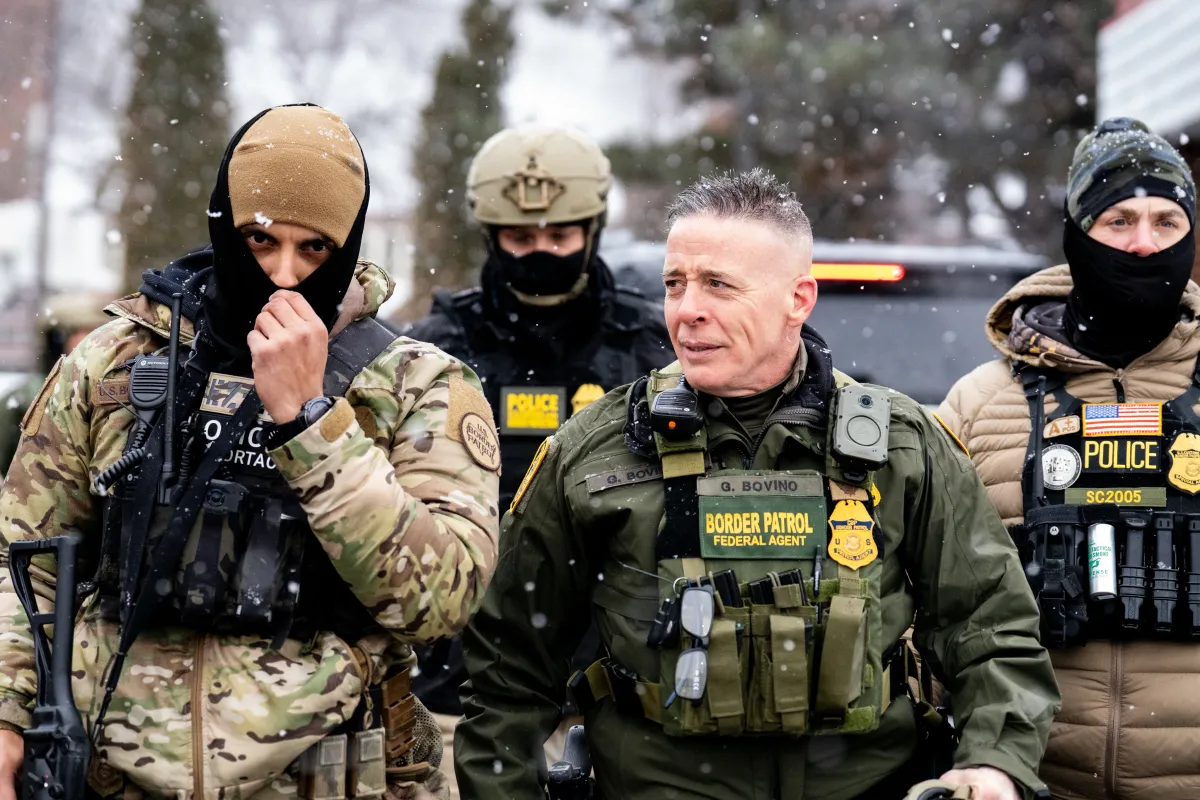
CHICAGO — Federal prosecutors on Tuesday released body-worn camera footage, text messages and internal emails tied to an October shooting in which a Border Patrol agent fired multiple rounds at a Chicago woman, an event that has strained departmental narratives and prompted fresh scrutiny of operational culture. A federal judge ordered the partial lifting of a protective order, concluding the government had shown little concern for the woman's reputation and allowing materials that include audible bodycam commentary and contemporaneous communications to enter the public record.
Bodycam footage and the moments before the shooting
The disclosed video captures the sequence leading up to and immediately after a collision between a Border Patrol vehicle and the civilian automobile driven by the woman, who had been following enforcement personnel while alerting neighbors to their presence. In the recording an agent audibly tells colleagues that they are "going to make contact" and a driver of the government vehicle turns sharply toward the civilian car moments before the impact. After the crash the agent who had been driving exits his vehicle with a weapon drawn and fires multiple rounds into the car, which then drove away and later sought emergency medical transport.
The film also records hostile language and derisive remarks directed at protesters and the drivers who followed the operation, intensifying public concern about the agents' mindset and the supervisory culture within the task force. Forensic reconstruction teams will need the vehicle handling data, dash and bodycam frames, and ballistic analysis to resolve whether the agents' steering input precipitated contact and from what angles bullets were fired. Those technical findings will be critical to determining whether the shooting comported with use-of-force standards or reflected avoidable escalation.
Additional documents disclosed by prosecutors suggest the government vehicle was later driven back to an out-of-state base and underwent repairs before defense teams could examine it, a sequence critics say complicates evidentiary preservation. Where evidence preservation protocols were not strictly maintained, independent experts warn that reconstructing precise trajectories and mechanical inputs becomes more difficult and may produce disputed interpretations during litigation.
Agent communications and tone
Court materials released alongside the video include text messages attributed to the agent who fired and to colleagues, some of which appear to celebrate marksmanship in the immediate aftermath. One message that prosecutors have highlighted describes rounds fired and references bullet holes; defense and civil-rights representatives argue such messages are self-incriminating and reveal a troubling post-incident attitude. The communications are now a central focus for both the factual record and for assessing whether cultural incentives encouraged aggressive tactics.
At the same time, phone and radio logs, timestamps and contemporaneous reports will be examined for corroboration; investigators will test whether messages were contemporaneous with the event or altered after the fact and whether they reflect coordination across personnel about how to narrate the incident. Forensic metadata and chain-of-custody documentation therefore matter as much as the textual content, and courts will consider both in adjudicating evidentiary disputes.
Newly public testimony and congressional briefings have amplified scrutiny of those messages, and lawmakers have invited department officials to explain both field conduct and internal communications. The political overlay means that technical findings will be filtered through a highly charged policy debate, increasing the stakes for neutral, methodical forensic work.
Initially, enforcement authorities released statements portraying the civilian as the aggressor who had "rammed" federal vehicles and stating that the agent fired in self-defense. The newly public materials complicate that account by showing a different sequence of vehicle motion and audible remarks that suggest the agents contemplated making contact. Where institutional narratives were once framed as immediate justifications for lethal force, the unsealed record injects factual ambiguity that legal actors and independent examiners must resolve.
The discrepancy between initial public statements and the contemporaneous recordings raises questions about internal review processes and about how quickly and how accurately departmental accounts were formed after the incident. Independent observers stressed that preliminary official statements, if issued before full technical review, can cement a public story that later evidence undermines, creating reputational harm that is difficult to erase even where criminal charges do not stand.
Supervisory praise and accountability questions
Among the documents released is an internal email from a senior Border Patrol commander sent the afternoon of the shooting that thanks the agent for his service and urges him to defer planned retirement, a message that critics cited as evidence of an internal culture of approbation. That communication prompted calls for explanation: oversight advocates want to know whether supervisory praise functioned as incentive for aggressive conduct or merely reflected a reflexive support for personnel. Questions about who authorized such communications and whether they reflect broader managerial norms will animate congressional and inspector-general queries.
Agency defenders counter that isolated internal messages do not by themselves determine culpability and that institutional hairline judgments should be distinguished from operational legality. Nonetheless, oversight officials and lawmakers are likely to probe the timeline of personnel communications, personnel reviews, and any intervening disciplinary steps to assess whether supervisory reactions aligned with policy and whether remedial training or administrative sanctions were appropriate.
Legal process and access to evidence
A federal judge’s decision to lift parts of the protective order was rooted in a balancing test between reputational harm and public interest, with the court concluding that limited disclosure was warranted to enable public understanding and to permit the civilian to clear her name. The ruling has immediate procedural consequences: some materials entered the public docket, defense counsel obtained fuller access for litigation planning, and the subject of the shooting pursued civil remedies aimed at damages and a formal repudiation of certain federal statements. The litigation path forward will involve motions about additional sealing, requests for independent forensic experts, and disputes over the scope of permissible public release.
The forensic phase will be lengthy and technical. Ballistic experts, vehicle dynamics analysts, electronic metadata specialists and independent reviewers will be needed to produce credible, court-admissible reconstructions. How courts manage competing expert reports and whether neutral special masters are appointed will shape the evidentiary record and influence both criminal and civil trajectories.
Beyond legal contestation, the released materials have policy resonance: they spotlight how federal enforcement operations are briefed publicly, the capacity of internal reviews to correct narratives, and the mechanisms by which evidence is preserved or altered after incidents. The episode arrives amid broader scrutiny of federal immigration enforcement following other high-profile uses of lethal force, intensifying debates about de-escalation training, mission parameters, and civilian oversight. Reform proposals circulating among lawmakers include clearer protocols for rapid forensic preservation, independent investigation triggers, and mandatory public release criteria where credibility questions are acute.
Restoring public trust will rest on transparent, timely, and technically robust investigations that are credible to courts, oversight bodies and the public alike. The coming weeks will test whether forensic reconstruction and judicial review can deliver definitive answers, whether departmental policies are updated to prevent recurrence, and whether accountability mechanisms produce both corrective and preventive outcomes.
Written by Nick Ravenshade for NENC Media Group, original article and analysis.
Sources: Reuters, Associated Press, Washington Post, Chicago Sun-Times, ABC7 Chicago.
Photo: “BORTAC and Greg Bovino” by Chad Davis, CC BY 4.0 | No Changes Made


Comments ()