WASHINGTON — An initial report to Congress from the Department of Homeland Security says two federal officers fired their service weapons during the fatal encounter with Alex Pretti in Minneapolis, marking the first official acknowledgment that multiple agents shot at the 37‑year‑old U.S. citizen as of 28 January 2026. The preliminary assessment, drawn from Customs and Border Protection’s internal inquiry, describes a brief struggle in which an officer repeatedly shouted that Pretti “has a gun” before a Border Patrol agent and a CBP officer discharged separate handguns at close range. The document stops short of saying whose rounds struck Pretti or whether he pointed a firearm at officers, leaving significant questions unresolved amid competing narratives from federal officials, local authorities and witnesses.
What the DHS preliminary report actually says
The report, prepared by CBP’s Office of Professional Responsibility, reconstructs the encounter using statements from the officers involved and other personnel on scene. It states that CBP personnel attempted to take Pretti into custody during an immigration enforcement operation, that he resisted those efforts, and that a physical struggle followed as officers moved to restrain him on the ground. During that struggle, a Border Patrol agent is said to have yelled variations of “he’s got a gun” several times, moments before two officers fired their agency‑issued weapons.
According to the document, approximately five seconds elapsed between the shouted warnings and the gunfire. Investigators write that a Border Patrol agent fired a Glock 19 handgun, while a CBP officer discharged a Glock 47, both standard sidearms in their respective units. After the shooting, a Border Patrol agent reported taking possession of what is described as Pretti’s firearm, which the report says was later cleared and secured in the agent’s vehicle. The preliminary account notes that CBP personnel then cut away clothing and applied chest seals as part of on‑scene medical aid before local emergency services transported Pretti to Hennepin County Medical Center, where he was pronounced dead around 9:30 a.m. local time on the day of the incident.
Key omissions and points of tension
Even as it confirms that two officers fired, the DHS document leaves out several elements that have shaped public debate. It does not specify how many bullets were fired, which shots hit Pretti, or whether forensic evidence can distinguish between rounds from the different weapons. The report also does not explicitly state that Pretti pointed or brandished a firearm at officers, referring instead to his resistance and to an agent’s perception that he “has a gun.” That contrasts with earlier public statements from senior officials, who suggested he posed an imminent threat during the encounter.
Video recorded by bystanders and reviewed by multiple news outlets shows an officer reaching into the scuffle and appearing to remove a handgun from Pretti’s waistband shortly before shots are heard. In one clip, the officer emerges holding a weapon and moves away from the group moments before a volley of gunfire. The DHS report insists that only agency‑issued weapons were fired, but it does not reconcile that finding with the timing of the apparent seizure of Pretti’s weapon seen in the footage. The lack of clarity on whether any of the shots might have come from Pretti’s gun has fueled speculation and underscores the importance of ballistic analysis and a full autopsy in resolving outstanding questions.
Conflicting narratives from federal and local officials
The preliminary report arrives amid starkly different accounts from federal leaders, local authorities and witnesses about what led up to the shooting. In earlier public remarks, senior officials said Pretti approached officers during a targeted operation while armed with a 9mm handgun and extra magazines, alleged that he “reacted violently” when they tried to disarm him, and cast the shooting as defensive. One top official went further, accusing Pretti of effectively committing “domestic terrorism,” language that has since drawn criticism from civil rights groups and some legal experts.
Local authorities and court documents tell a different story. Minneapolis officials have said that Pretti was a lawful gun owner with a permit to carry and that his only prior interactions with law enforcement were minor traffic violations, facts later echoed by family statements and neighbors. A sworn declaration filed in federal court by a witness, whose name was redacted, alleges that agents pepper‑sprayed observers and shoved a woman to the ground before Pretti moved to assist her, rather than arriving to attack officers. The divergence between those accounts and the tone of some federal statements has heightened scrutiny of the DHS narrative, particularly where the initial report is silent on key claims about intent and threat level.
Who is Alex Pretti, and why his case resonates
Details emerging about Pretti’s life have added emotional weight to the case and intensified public reaction. Born in Illinois and a U.S. citizen, he worked as an intensive care nurse at the Minneapolis Veterans Affairs hospital, caring for severely ill military veterans. Family members have described him in statements as a “kindhearted soul” devoted to his patients, relatives and friends, and said he had taken part in recent protests in Minneapolis following another fatal shooting earlier in the month.
Neighbors and colleagues have recalled a man who helped with small tasks around the community and who they say was deeply affected by previous high‑profile incidents of violence in the city. For activists and local residents, those details reinforce a perception that the shooting reflects broader issues in the way federal enforcement operations unfold in densely populated neighborhoods. The fact that Pretti was not the original target of the immigration operation, which focused on a different individual with a prior criminal history, has further sharpened questions about proportionality and risk management.
Multiple investigations and the road to accountability
The DHS report is only one strand in a web of ongoing investigations. CBP’s Office of Professional Responsibility is conducting the internal review that produced the initial document, focused in part on potential criminal conduct by officers and compliance with agency policies. Other probes involve DHS investigative units and Minnesota’s Bureau of Criminal Apprehension, which is examining evidence under state law, including use‑of‑force standards and possible charges.nbcnews+3
Key pieces of information have yet to be released publicly. A full autopsy from the county medical examiner’s office is pending, with investigators indicating they plan to obtain official findings once available. Ballistic tests will be needed to establish the number of rounds fired, the trajectory of bullets and which weapon or weapons caused which wounds. Officials have not said when body‑camera footage or additional video from the officers will be disclosed, if at all, citing standard practice to protect the integrity of investigations, even as pressure mounts from local leaders and civil liberties groups for greater transparency.
Policy questions for DHS and the White House
Beyond the specifics of the case, the initial report has renewed debate over DHS use‑of‑force policies and how they are applied in domestic operations far from international borders. Advocacy groups and some lawmakers have raised concerns that standards designed for border environments may not translate safely to crowded urban settings, especially when combined with aggressive tactics such as large‑scale raids and heavy reliance on heavily armed units. The Pretti shooting is the second fatal encounter involving federal immigration personnel in Minneapolis this month, a pattern that has led to calls for a broader review of how such operations are authorized and overseen.
For the White House and DHS leadership, the internal findings present both a test of oversight mechanisms and a political challenge. On one hand, the report’s acknowledgement that two officers fired their guns and that only agency‑issued weapons were used addresses some specific questions that emerged after early reports and video clips. On the other hand, its omissions on key points, combined with the discrepancies between the narrative in official statements and in court documents, leave officials open to criticism that initial public messaging may have outpaced the evidence. How authorities handle the next stages, including transparency around evidence and any disciplinary or criminal decisions, will shape public trust not only in this case but in DHS operations more broadly.
As of 28 January 2026, Pretti’s family has called for an independent investigation and for the full release of body‑camera footage, while witnesses continue to submit sworn accounts that challenge core elements of the government’s description. The DHS preliminary report, by confirming that two officers fired but leaving critical questions unanswered, underscores how far the process still has to go before a definitive public record of the shooting is established.
Written by Nick Ravenshade for NENC Media Group, original article and analysis.
Sources: Sources: CNN, CBS News, NBC News, ABC News, Ground News, Fox News, KOSU, academic and policy research (arXiv)
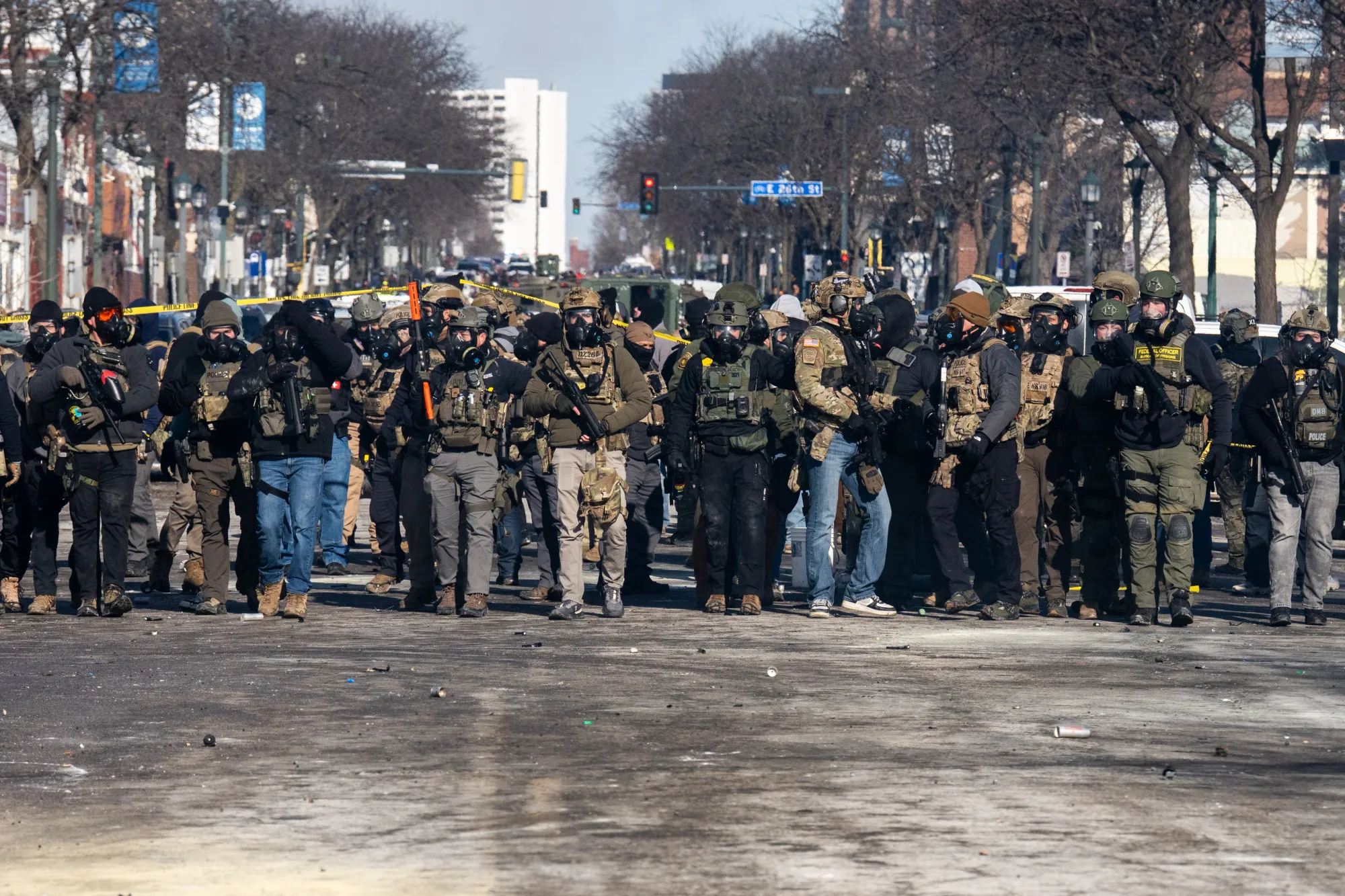
Photo: “Line of federal agents in Minneapolis” by Chad Davis, CC BY 4.0 | No changes made
Author

Nick Ravenshade, LL.B., covers geopolitics, financial markets, and international security through primary documents, official filings, and open-source intelligence. Founder and Editor-in-Chief of NENC Media Group and WarCommons.
Sign up for NENC Now newsletters.
Stay up to date with curated collection of our top stories.