Minneapolis immigration raid turns deadly as federal officers fatally shoot man, fueling protest and scrutiny
MINNEAPOLIS — A man shot by federal immigration officers during a large-scale enforcement operation in south Minneapolis on Saturday has died in hospital, intensifying public anger in a city still grappling with the legacy of previous fatal encounters involving federal agents as of 24 January 2026. Federal officials say the man was armed and resisted attempts to disarm him, while local authorities report that he was a longtime resident and a U.S. citizen, highlighting sharp early discrepancies in how the incident is being described. Within hours of the shooting, hundreds of demonstrators converged on the scene and downtown streets, denouncing the federal presence and demanding an immediate halt to the current immigration crackdown.
Conflicting accounts of a deadly encounter
According to federal and local officials, the shooting occurred on Saturday morning on the city’s South Side, during what authorities described as a targeted operation focused on an individual identified as undocumented, armed and wanted in connection with an alleged violent assault. Federal officers say that as they moved to apprehend their target, another man approached while carrying a 9mm handgun and at least two magazines, prompting agents to attempt to disarm him. In a written statement, the federal agency involved asserted that the man “violently resisted,” leading one officer to open fire out of fear for personal safety and that of fellow officers.
Local officials later offered additional details that complicate the picture. At an afternoon press conference, the city’s police chief said the victim was a male resident believed to be a U.S. citizen with only minor prior interactions with law enforcement, primarily related to traffic violations. The chief also indicated that the man possessed documentation for a lawful firearm license and that preliminary information suggested he may have been carrying the weapon legally when he encountered federal officers. Hospital and law enforcement accounts concur that the man suffered multiple gunshot wounds and was later pronounced dead at Hennepin County Medical Center, though they have not publicly disclosed his name pending notification of relatives.
A city on edge after earlier federal shootings
Saturday’s incident is the latest in a string of confrontations involving federal immigration and border officers in Minneapolis this month, amplifying concerns among residents and local leaders about the conduct and oversight of federal operations in the city. Earlier in January, a 37-year-old woman was shot and killed when a federal agent discharged a weapon into her vehicle during a traffic encounter in south Minneapolis, prompting city officials to issue a sharply worded statement accusing the agent of recklessly using power. In another separate case, an immigrant from Venezuela was shot during an enforcement action, though he survived; both incidents have become rallying points for activists who argue that the current operation carries unacceptable risks for residents.
City officials have expressed frustration that they have limited authority over federal officers operating within Minneapolis, even as they bear responsibility for managing public reactions and maintaining order. The mayor previously warned that the expanded federal presence could lead to exactly the type of incident that unfolded on Saturday, saying the city had “dreaded this moment” since early in the deployment. Those fears appear to have been borne out as tensions spike in neighborhoods where residents report frequent sightings of heavily armed agents, unmarked vehicles and rapid arrest operations.
Governor calls for immediate halt to federal operation
The shooting prompted a swift response from Minnesota’s governor, who publicly condemned the incident and urged the White House to suspend the ongoing immigration crackdown in the state. In a social media post on Saturday morning, the governor described the situation as “intolerable” and called on President Donald Trump to order federal agencies to end the current deployment and withdraw large numbers of officers from Minnesota. The governor said he had spoken with a senior White House official following the shooting and reiterated his view that the federal operation posed a threat to public safety rather than enhancing it.
Federal authorities have defended the operation as a necessary response to what they characterize as violent threats and immigration-related offenses, calling it one of the largest and most complex enforcement initiatives currently underway in the country. They argue that agents are targeting individuals deemed dangerous and that officers are trained to use force only when they perceive imminent threats. However, state and local officials say they have received little detailed information about criteria for targeting, rules of engagement or how federal teams coordinate with city police, leaving gaps that complicate oversight and communication with the public.
Protesters clash with agents as outrage grows
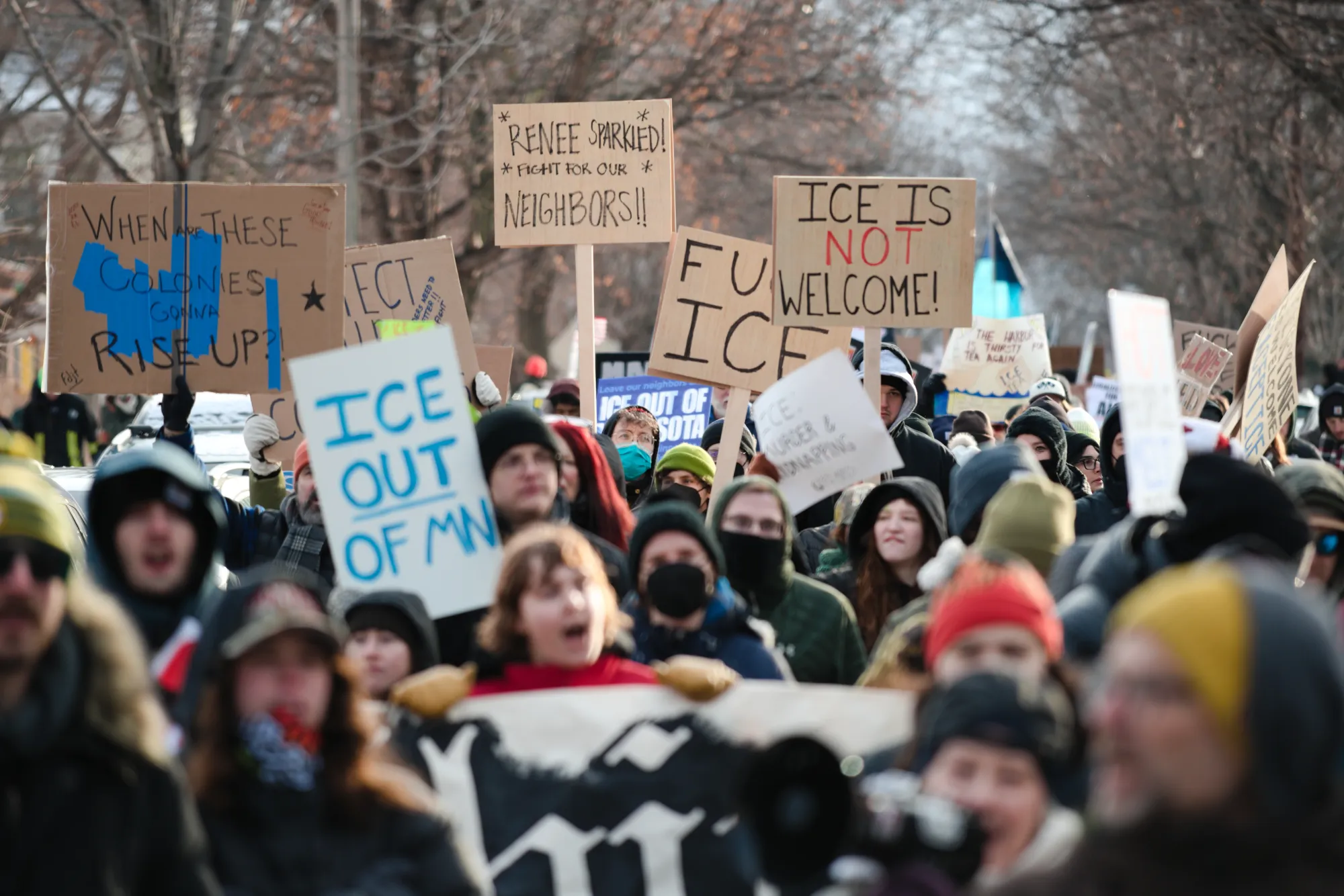
In the hours after news of the shooting spread, crowds gathered near the scene and later in downtown Minneapolis to protest the federal presence and demand accountability for the latest killing. Witness accounts and video from the area show demonstrators shouting at officers, calling them “cowards” and urging them to leave the city, while some protesters moved dumpsters and other objects into streets to create makeshift barricades. Chants of “ICE out now” echoed through the neighborhood as residents expressed anger that another deadly incident had occurred amid mounting concerns about aggressive tactics.
Federal officers responded by forming lines, using batons and deploying flashbang devices to disperse parts of the crowd, actions that further inflamed tensions. Video captured at the scene shows at least one officer pushing a protester into a vehicle and another walking away while dismissively saying “boo hoo,” remarks that have circulated widely on social media and drawn criticism from local officials and civil rights advocates. Protest organizers say they expect larger demonstrations in coming days, building on previous marches against the immigration operation that already drew thousands of participants despite cold weather.
Legal questions and investigative steps ahead
Multiple investigations are now underway to determine whether the officers’ use of deadly force complied with federal policies, state law and constitutional protections. The federal agency involved has said that its internal oversight body and an independent inspector unit will review body-camera footage, radio communications, weapons discharges and other evidence. Local authorities, including the Minneapolis Police Department and county prosecutors, are also gathering information, though their jurisdiction over federal personnel is constrained by legal and institutional boundaries.
Key factual questions include whether the man who was shot pointed or attempted to use the firearm, whether officers clearly identified themselves and issued commands that were audible and understandable, and how many agents fired their weapons. Officials have acknowledged that the victim was shot multiple times, possibly by more than one officer, but have not yet released a full ballistic breakdown or timeline of the encounter. The lack of public body-camera footage to date has also fueled calls from advocates and some city leaders for rapid disclosure, though investigators typically argue that early releases can complicate witness testimony and case integrity.
Broader implications for immigration policy and public trust
The Minneapolis shooting lands amid an intensifying national debate over immigration enforcement, policing practices and the role of federal agents in local communities. Supporters of tougher enforcement argue that federal authorities must be able to carry out operations in jurisdictions where they believe local policies have impeded previous efforts to detain and remove individuals who pose security risks. Critics counter that aggressive tactics, particularly in densely populated urban neighborhoods, heighten the risk of lethal encounters, erode trust in law enforcement and disproportionately affect communities of color and mixed-status families.
Researchers tracking deaths and serious incidents in federal immigration custody and during enforcement actions have documented recurring concerns about accountability, transparency and oversight mechanisms. Past cases involving use of force have led to internal policy reviews, civil litigation and calls for independent monitoring, but advocates say reforms have been uneven and often slow. For Minneapolis, which has played a prominent role in national conversations about policing since earlier high-profile killings, the latest incident raises the prospect of renewed scrutiny and potential federal-state tension over who ultimately sets the terms for law enforcement within city limits.
As of 24 January 2026, the victim’s name and full background have not been made public, and investigators have released only limited information about the officers involved, including their precise roles and years of service. The coming days are likely to bring further protest activity, political responses and more detailed disclosures from multiple agencies, each shaping public understanding of what happened on a Minneapolis street that morning. Whether the incident prompts changes in the federal operation, new state-level oversight proposals or broader shifts in national enforcement policy remains an open question, but the immediate impact is a deepened sense of unease in a city once again at the center of a national conversation about force and accountability.
Written by Nick Ravenshade for NENC Media Group, original article and analysis.
Sources: NPR, Associated Press/PBS NewsHour, Al Jazeera, New York Times, Minneapolis City Government, MPR News/Instagram, academic and medical research (Wiley, PMC, Taylor & Francis).
Photo: “Protest against ICE in Minneapolis” by Fibonacci Blue, CC BY 4.0
Author

Nick Ravenshade, LL.B., covers geopolitics, financial markets, and international security through primary documents, official filings, and open-source intelligence. Founder and Editor-in-Chief of NENC Media Group and WarCommons.
Sign up for NENC Now newsletters.
Stay up to date with curated collection of our top stories.