WASHINGTON — The United States and Iran edged closer to a potential military confrontation this week as the Pentagon assembled its largest concentration of combat power in the Middle East since the 2003 invasion of Iraq, while a second round of nuclear negotiations in Geneva produced only a provisional agreement on procedural principles, leaving the substantive chasm between Washington's demands and Tehran's red lines as wide as ever.
The deployment, which now includes two aircraft carrier strike groups and more than 120 aircraft, unfolds against a backdrop of deliberate and increasingly visible ambiguity. President Donald Trump has repeatedly threatened force if Tehran refuses to accept new constraints on its nuclear program, while simultaneously leaving the parameters of any acceptable deal undefined. That ambiguity, intended to generate diplomatic leverage, has instead produced a dynamic that several current and former Western officials describe as increasingly difficult to reverse without either capitulation or conflict. One current official, who requested anonymity to discuss internal deliberations, said Trump is now in part "boxed in by his own show of force".
The Military Posture: Two Carriers, 120 Aircraft, and a Disputed Base
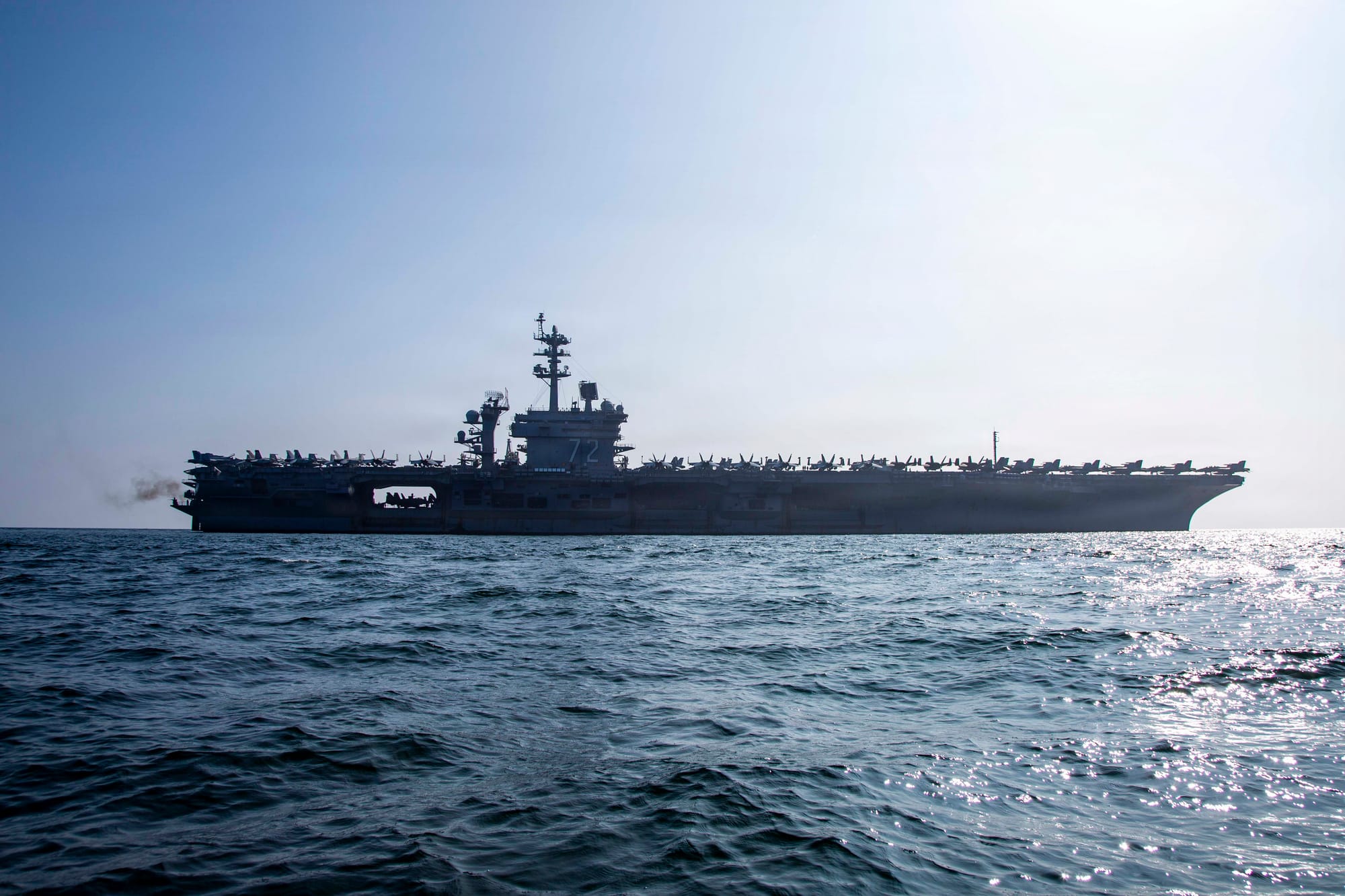
The USS Abraham Lincoln carrier strike group has been operating in the Arabian Sea since late January 2026, redirected from the South China Sea following Trump's escalating rhetoric toward Iran. The group brought approximately 5,700 additional service members to the region, augmenting a smaller force of destroyers and littoral combat ships already present. Two weeks later, Trump ordered the USS Gerald R. Ford, the world's largest aircraft carrier, to transit toward the region. The Ford was photographed crossing the Strait of Gibraltar on February 20, 2026, placing it on course for the eastern Mediterranean and, potentially, the broader operational theater around Iran.
Open-source flight-tracking data has recorded substantial surges in military aviation activity at bases stretching from the continental United States through the United Kingdom and into the Gulf. Aircraft movements observed at RAF Mildenhall and RAF Lakenheath in England include tankers and fighter aircraft, consistent with the support architecture required for long-range sustained strike operations. At Al Udeid Air Base in Qatar, the primary US command hub for Middle East operations, analysts tracking open-source data counted at least 20 KC-135 Stratotanker aerial refueling aircraft by late January 2026, a marked increase over baseline levels. Defense analysts at the Brookings Institution have characterized the current buildup as the region's largest since 2003, while noting that the force package remains several orders of magnitude smaller than the half-million troops deployed during Operation Desert Storm.
Complicating the strategic picture is a dispute with a close ally. The UK government, according to multiple reports in British media corroborated by a statement from the US State Department this week, has declined Washington's request to use Diego Garcia, the joint UK-US base in the Indian Ocean, and RAF Fairford in England for new strikes on Iran, on the grounds that such use would breach international law. Diego Garcia sits roughly 2,350 miles from Iran and serves as the principal forward deployment site for the B-2 Spirit stealth bomber, the aircraft that delivered bunker-busting munitions against hardened Iranian nuclear infrastructure in June 2025. Trump responded to the UK's position by withdrawing American support for London's agreement to transfer sovereignty of the Chagos Islands, which includes Diego Garcia, to Mauritius, publicly calling the arrangement "an act of GREAT STUPIDITY." Whether B-2 strategic bombers are currently positioned at Diego Garcia could not be independently confirmed as of this report.
The present standoff is inseparable from the events of June 2025, when the United States joined an Israeli military campaign against Iran and deployed B-2 bombers to strike three of Tehran's principal nuclear facilities: Fordow, Natanz, and Isfahan. That operation, conducted under the name Midnight Hammer, targeted what US and Israeli officials described as the core of Iran's uranium enrichment capability. Both governments subsequently claimed the strikes had "obliterated" the nuclear program. Iran retaliated by launching more than a dozen ballistic missiles at Al Udeid Air Base in Qatar. US forces had conducted a partial evacuation of the base in anticipation of the counterattack; 44 air defense soldiers remained behind and prevented the facility's destruction. No American fatalities were reported in the retaliation, though the structural damage to Al Udeid and its operational tempo was significant.
Since Midnight Hammer, Iran has moved quickly to limit the damage. Satellite imagery analyzed by commercial providers and reviewed by multiple outlets shows that Iran has buried the tunnel entrances at one bombed nuclear site under concrete, fortified access points at others, and repaired missile bases struck during the conflict. Iran has also stated it halted uranium enrichment activity following the June strikes. However, the precise status of Iran's enriched uranium stockpiles, including the location of material enriched to near-weapons-grade levels before the strikes, has not been confirmed by the International Atomic Energy Agency. The IAEA's director general met with Iranian Foreign Minister Abbas Araghchi in Geneva on February 16, 2026, the day before the second round of US-Iran nuclear talks, suggesting that inspection access and transparency remain live negotiating issues.
The Geneva Talks: Guiding Principles but No Agreement
The second round of indirect nuclear negotiations between Washington and Tehran took place in Geneva on February 17, 2026, facilitated by Oman and conducted at the residence of the Omani ambassador to the United Nations. Araghchi, the head of the Iranian delegation, described the outcome as productive in procedural terms. "I believe we made good progress," he said after the session, adding that "the path toward an agreement has started but we will not reach it quickly." He said the two sides had agreed on a set of "guiding principles" for how a final deal might be structured, and indicated that Iran would prepare a written proposal for submission to US negotiators before a subsequent round. A US official, speaking without attribution, confirmed that "progress was made, but there are still a lot of details to discuss."
The substantive distance between the parties nonetheless remains substantial. Trump and senior administration figures have repeatedly stated publicly that the United States requires Iran to completely and permanently dismantle its nuclear program, including surrendering the right to enrich uranium at any level. Araghchi contradicted that framing directly on February 20, stating that "the US side has not asked for zero enrichment" in the actual negotiating sessions, a claim at odds with the administration's stated public position and one that the White House has not publicly addressed. Iran has indicated it is prepared to accept rigorous monitoring, significant enrichment limits, and enhanced IAEA access, but has categorically refused to abandon enrichment as a sovereign right under the Nuclear Non-Proliferation Treaty. Trump set a public deadline of roughly "10 to 15 days" for a deal, a timeline that expires in early March 2026.
Iran's Strategic Calculus and the Risk of Miscalculation
Tehran's diplomatic and military responses to the buildup reflect a government managing acute pressure under significant institutional constraint. Iran has signaled openness to a deal, conducted high-profile diplomatic outreach through Araghchi to Turkey and regional partners, and participated in two rounds of indirect talks within six weeks. At the same time, it has staged large-scale maritime exercises, including a closure of the Strait of Hormuz for live-fire drills conducted simultaneously with the Geneva negotiations, a deliberate signal that Tehran retains the ability to disrupt global oil flows in the event of military action. The Strait handles roughly a fifth of global oil trade.
Iran has also pursued a parallel effort to harden its deterrence posture. Beyond the physical fortification of nuclear sites, analysts at critical threat-monitoring organizations have tracked Iranian efforts to deepen underground facilities, preserve key assets below the effective penetration depth of existing American munitions, and develop a layered defense relying on mines, missiles, submarines, and drones intended to impose costs on any attacking force. The strategic goal appears to be not victory in a military exchange but rather a sufficient capacity to retaliate in ways that would make the cost of American action politically prohibitive. Whether that calculus holds against a US force package of the current scale, operating potentially without access to Diego Garcia, is a question that no public analysis has resolved, and one that both governments appear to be actively computing in real time.
Written by Nick Ravenshade for NENC Media Group, original article and analysis.
Author

Nick Ravenshade is Editor-in-Chief at NENC Media Group, overseeing global markets and finance coverage with a focus on transparency and independence. He previously covered financial regulation and geopolitics for local news media outlets.
Sign up for NENC Media Group newsletters.
Stay up to date with curated collection of our top stories.