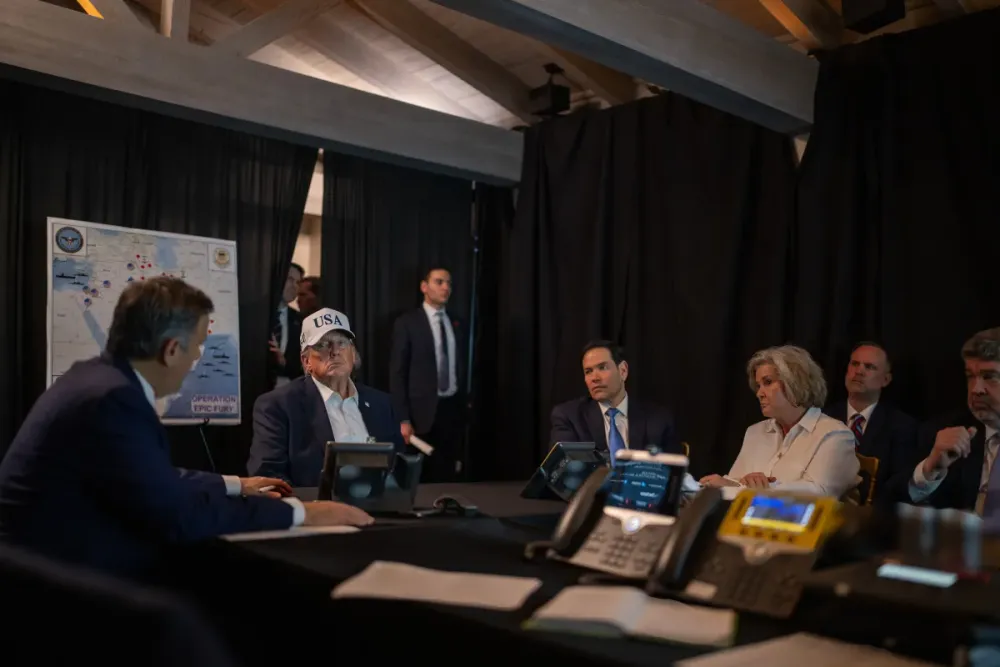
WASHINGTON — Lawmakers emerged from a classified Pentagon briefing visibly shaken after being shown video of a September 2 “double-tap” strike on a vessel in international waters that left survivors dead. The footage, lawmakers said, depicts people clinging to wreckage after an initial strike and then being struck again by a follow-on attack. Members from both parties described the material as deeply disturbing and said it raised urgent legal and oversight questions about who authorized the sequence of strikes and what rules guided the operation.
The session, led by a senior naval officer who answered members’ questions behind closed doors, did not settle the central dispute: whether senior civilian leaders explicitly ordered follow-up force to kill survivors or whether commanders on scene made the tactical call. Lawmakers said investigators and committee staff would press for additional documents and testimony in coming days. Legal scholars and human-rights experts, meanwhile, reiterated that deliberately striking those hors de combat or rescuers would be unlawful under the laws of armed conflict.
What lawmakers say they saw
Several lawmakers who attended the briefing described the same basic sequence: an initial strike that disabled or sank a small boat thought to be carrying narcotics, followed minutes later by a second strike on lingering wreckage and people in the water. One ranking member called the footage “one of the most troubling things” he had seen in public service. Other attendees used words such as “horrific” and “unsettling” to describe what they saw but stopped short of drawing final legal conclusions in public remarks.
Officials at the briefing said the military portrayed the second strike as necessary to prevent the vessel from remaining operational or to deny a target that could be used again. Attendees said commanders discussed how the sequence fit the administration’s broader campaign against maritime drug-trafficking networks. Lawmakers left the room focused on two questions: whether a civilian leader gave a directive that effectively required lethal follow-on force, and whether the legal justifications provided to Congress were sufficient and transparently documented.
Disputed orders and the limits of verification
A central and contested allegation in reporting about the September mission is that a senior civilian leader issued a verbal instruction that has been paraphrased in some outlets as an order to “kill everybody.” That formulation has been cited in multiple accounts based on anonymous sourcing and attributed reporting. The claim cannot be corroborated in an official written order made public as of 4 Dec 2025. Committee staff and investigators told lawmakers they will seek contemporaneous communications, logs, and witness statements that could corroborate or refute the allegation.
By contrast, the admiral who briefed Congress reportedly denied there was an order to “kill them all” and told lawmakers that operational commanders made subsequent tactical judgments. That public denial, as described by attendees and reflected in official readouts, forms part of the record now being investigated. The gap between the reported anonymous attribution and the admiral’s account has sharpened lawmakers’ demands for documentary trail evidence: call records, message logs, or written directives that would clarify who set operational boundaries before the mission began.
Legal and policy stakes
If investigators conclude that personnel intentionally targeted people who were hors de combat — that is, wounded, shipwrecked, or otherwise incapable of fighting — that finding would raise potential violations of international humanitarian law and U.S. military regulations. Legal experts who study use-of-force doctrine said the line between a legitimate military target and a protected person can hinge on fine, fact-specific details: whether individuals retained the capability and intent to continue an armed mission, whether they posed an imminent threat, and whether commanders took feasible precautions to minimize civilian harm.
Observers also highlighted the policy implications for a campaign that has systematically prioritized maritime interdiction. A pattern of aggressive follow-on strikes could alter how partner nations, regional maritime authorities, and courts view U.S. operations. It could complicate cooperation with coastal states and raise questions about escalation dynamics in an already tense maritime environment. Senior lawmakers emphasized that beyond any criminal-law questions, Congress must determine whether current authorization and oversight mechanisms are adequate for the scale and character of these operations.
Oversight, records, and what comes next
Committee staff are now seeking a broader packet of material, including classified legal memoranda that the administration has reportedly shared with some members, mission logs, and communications between civilian leaders and operational commanders. Lawmakers said they intend to hold further classified depositions and may consider subpoenas if requested records are not forthcoming. Several lawmakers called for a public accounting once the classified review reaches a point where disclosure would not jeopardize sources or methods.
Beyond congressional processes, military investigators and the department’s legal apparatus have roles to play. Officials said there would be internal reviews to determine whether the operation complied with standing rules of engagement and the guidance provided by legal advisers. For the public, the next weeks are likely to be a test of whether the administration and the Pentagon can produce a coherent, document-backed narrative that addresses the legal concerns and operational rationale lawmakers raised after seeing the footage.
Broader context and international response
The strike sits in the context of an intensified campaign of maritime attacks that the administration says targets organized criminal networks responsible for transnational drug flows. Independent reporting and official briefings have placed the number of known strikes and fatalities in a range that has shifted as new information emerged; different outlets and officials have reported differing tallies. Regional governments and international legal observers have expressed concern, urging transparency and adherence to international law while some allied capitals have sought clarifying briefings from U.S. officials.
Human-rights groups and some legal scholars argued that a strategy that accepts or employs follow-on strikes to finish survivors or responders has historic precedents that drew heavy scrutiny and criticism. Those analysts said transparent legal justification, clear rules of engagement, and independent review are essential to preserving the legitimacy of any campaign that operates in international waters and affects foreign nationals.
The classified briefing produced two immediate results: heightened congressional scrutiny and a widening partisan and legal debate over the permissibility and oversight of follow-on maritime strikes. Lawmakers and investigators will now push for the documentary and testimonial evidence necessary to reconcile competing public accounts. How the Pentagon and civilian leaders respond will determine whether the episode becomes a singular controversy or a fulcrum for broader policy change governing the use of force at sea.
Written by Nick Ravenshade for NENC Media Group, original article and analysis.
Sources: The Washington Post, AP News CNN Transcripts, Al Jazeera.
Author

Nick Ravenshade, LL.B., covers geopolitics, financial markets, and international security through primary documents, official filings, and open-source intelligence. Founder and Editor-in-Chief of NENC Media Group and WarCommons.
Sign up for NENC Now newsletters.
Stay up to date with curated collection of our top stories.