Minab School Death Toll Reaches Up to 180 as Mass Funeral Draws Thousands, UN Demands Investigation and US Still Has Not Accepted Responsibility
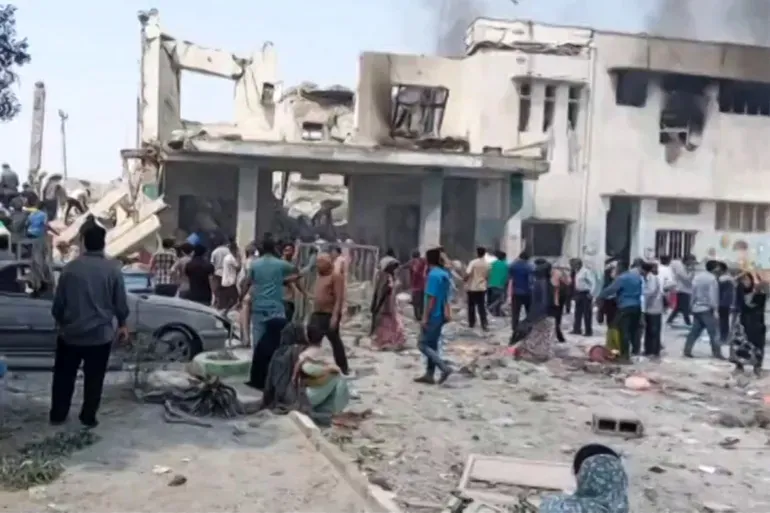
DUBAI — The death toll from Saturday's strike on the Shajareh Tayyebeh girls' elementary school in the southern Iranian city of Minab has risen to between 165 and 180 people according to Iranian official and state media sources, the majority of them schoolchildren, as thousands attended a mass burial ceremony on Tuesday and the United States still had not formally accepted or denied responsibility four days after the strike occurred.
Death Toll Escalates Across Multiple Conflicting Official Counts
Iranian state media's initial report of five dead, published within hours of the Saturday morning strike, understated the scale of the disaster by an order of magnitude. By Sunday, Tasnim news agency had revised the figure upward to 148 killed. The local prosecutor's office in Minab cited 165 dead and 96 injured in a statement carried by the state news agency IRNA on Sunday, with the Minab mayor placing the figure at 168. Iran's Health Ministry spokesman Hossein Kermanpour subsequently said approximately 180 children had been killed, adding that additional bodies may still lie beneath the rubble. Given the pace and direction of revisions, the total figure across all official Iranian sources must be understood as a floor rather than a ceiling, and remains unverified by any independent on-the-ground count, as access to the site by outside journalists was not confirmed as of Tuesday.
Video footage of the destroyed school, showing the full collapse of the building over the student body inside, was independently verified as authentic by four separate outlets through comparison with existing pre-strike imagery of the site. NBC News published a first-person account from a mother whose son was killed in the strike, with the woman describing arriving at the school after the impact and witnessing rescue workers removing dismembered remains of children from the rubble. The account, gathered on condition of anonymity for safety reasons, is consistent with the physical destruction visible in verified footage and aligned with the testimony of local officials. No survivor account or independent report contradicts the core factual claim that a functioning girls' elementary school was destroyed and that the majority of casualties were children.
US and Israel Maintain Distance as International Condemnation Mounts
Secretary of State Marco Rubio told reporters on Monday that US forces "would not deliberately target a school," adding that the Pentagon would investigate "if that was our strike." US Central Command had said over the weekend that it was looking into reports of civilian deaths, a formulation that fell short of acknowledging any strike took place. The Israeli military said it was not aware of any Israeli or US strikes in the Minab area, a statement it had not updated or retracted as of Tuesday. The divergence between Iranian casualty documentation and the combined silence of Washington and Tel Aviv has now persisted across four days and a publicly witnessed mass funeral, a gap that UN officials and human rights monitors are treating as a matter of pressing accountability concern.
UNESCO formally condemned the strike as a grave violation of international humanitarian law. UN Secretary-General António Guterres condemned the deaths. The UN Human Rights Office called for a prompt, impartial, and thorough investigation, with spokesperson Ravina Shamdasani noting the office lacked sufficient information to make a final determination of responsibility. Nobel Peace Prize laureate and UN Messenger of Peace Malala Yousafzai also condemned the strike publicly. Iran's Foreign Minister Abbas Araghchi stated on Monday that the US and Israel were responsible, calling the deaths a documented case of aggression against civilians. Iran's Foreign Ministry spokesperson called on the UN Security Council to act under its primary Charter responsibilities.
Mass Funeral Becomes Political Flash Point as IHL Questions Deepen
Thousands gathered in a public square in Minab on Tuesday for the mass burial ceremony, with Iranian state television broadcasting the event nationally. A woman who identified herself as the mother of a student named Atena addressed the crowd, holding printed portrait images of the dead, which she described as "a document of American crimes." The crowd chanted against the policies of the United States and Israel throughout the ceremony. A mass burial site with rows of individual graves dug side by side was visible in verified imagery circulated by state media and regional outlets, consistent with a death toll in the hundreds rather than the single digits reported in initial coverage.
The central legal and investigative question the mass funeral did not resolve is whether the Shajareh Tayyebeh school building was a lawful military target at the time of the strike. Both the Minab town mayor and the mother who spoke to NBC News independently confirmed that the school was constructed on the site of a former IRGC base, which had been closed for approximately 15 years prior to the strike, with all military personnel relocated and the school remaining in continuous civilian educational use. That confirmation, sourced from local officials rather than the Iranian central government, significantly complicates any post-hoc military justification. A building that functioned for 15 years as a civilian school on former military land does not carry active military objective status under the Geneva Conventions, and a strike causing 165 to 180 deaths in such a facility would require extraordinary evidence of active military use at the precise time of the attack to withstand scrutiny under the proportionality and precaution principles of international humanitarian law.
For full background, see prior coverage at:
 Nick Ravenshade
Written by Nick Ravenshade for NENC Media Group, original article and analysis.
Author

Nick Ravenshade, LL.B., covers geopolitics, financial markets, and international security through primary documents, official filings, and open-source intelligence. Founder and Editor-in-Chief of NENC Media Group and WarCommons.
Sign up for NENC Now newsletters.
Stay up to date with curated collection of our top stories.