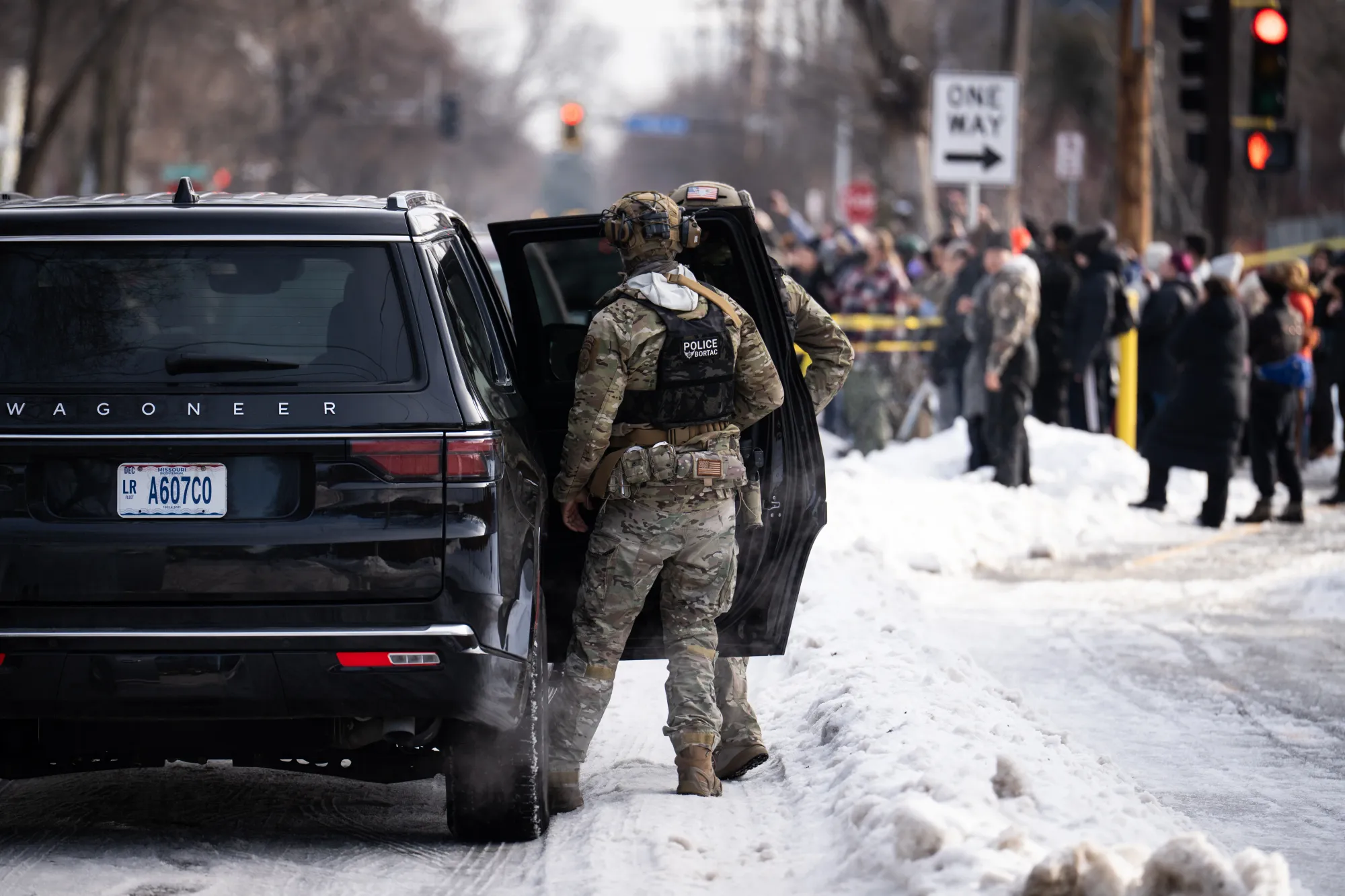
MINNEAPOLIS — Renee Nicole Macklin Good, a 37-year-old mother and local resident, was shot and killed by a federal Immigration and Customs Enforcement officer in south Minneapolis on January 7, 2026, during a large-scale immigration enforcement operation, triggering protests, urgent political responses and parallel state-federal investigations. Federal officials said the officer fired after the driver attempted to use her vehicle as a weapon against personnel at a blockade, while city leaders and bystanders said video of the encounter contradicts that account. The shooting rapidly became a flashpoint in debates over federal enforcement tactics, public safety during large operations and the standards governing the use of deadly force.
Shooting and competing narratives
Federal spokespeople described an operation that encountered obstruction and said an officer deployed his firearm when the vehicle moved in a manner that presented an imminent threat. They characterised the action as defensive and said the involved agent was evaluated and treated for a non-life-threatening injury. City officials disputed that account strongly, stating their review of the available video does not support the administration's version and accusing federal teams of escalating the confrontation.
Local authorities and multiple witnesses described a chaotic sequence in which federal agents surrounded a maroon SUV that was partially blocking the roadway. Some clips show an officer grabbing at the driver's door and other agents approaching from different angles, producing a situation where the vehicle appears to move both backward and forward in short bursts. Shots were fired at close range as the vehicle moved; the car then accelerated into parked vehicles and struck a utility pole, leaving a community stunned and searching for immediate answers.
The municipal record and the federal narrative diverge on key points, including whether an officer made contact with the vehicle, the timing of the shots, and whether the driver posed an imminent danger when the first round was fired. Those disputed factual elements are now the focus of investigators and are central to whether the shooting will be treated as justified self-defense or an avoidable use of lethal force. The competing narratives have already shaped public reaction and early political responses.
Video, witnesses and scene evidence
Multiple bystander videos taken from different vantage points became central to public debate because each clip contains fragments of key moments that both sides interpret differently. One camera angle appears to show the vehicle inch forward as an officer grabs the door; another shows an agent at the front of the car firing as the vehicle appears to pass by. None of the publicly available clips, however, provide a full, continuous record of the encounter’s intent, precise speed, or whether any officer suffered physical contact before shots were fired.
Witnesses at the scene reported that federal agents also used crowd-control measures and pushed back observers before and after the shooting, and family members said the woman had recently moved to the neighbourhood and had dropped off a child at school earlier that morning. Demonstrators quickly gathered and described a perceived pattern of heavy-handed enforcement by federal teams operating in urban areas, while other residents urged restraint and emphasised the need for investigators to establish a reliable timeline before public judgment. Independent observers and legal analysts noted the importance of chain-of-custody protocols for video and other evidence to ensure forensic reconstructions can be trusted.
Legal and investigative process
State and federal authorities have opened inquiries to determine whether the use of deadly force complied with applicable law and agency policy. The state-level probe will examine compliance with local and state use-of-force standards, while federal reviewers will analyse adherence to departmental directives and federal statutes that govern agents' conduct. Investigators have said they will seek body-worn camera footage where available, collect vehicle telemetry and examine ballistic evidence and medical examiner reports to reconstruct the sequence of events.
A joint investigative approach increases the likelihood of a technically thorough reconstruction, but it also introduces procedural complexity as jurisdictions coordinate on evidence handling and disclosure protocols. Investigators will assess whether internal policy failures, inadequate training or operational planning flaws contributed to the outcome. The administrative and criminal consequences will hinge on whether the physical record and corroborating testimony support a finding of unlawful use of force or establish that an officer reasonably perceived an imminent threat.
Public response and political fallout
The shooting prompted immediate vigils, mass gatherings and sharply worded statements from municipal leaders demanding accountability and limits on federal operations in city spaces. The mayor publicly urged federal teams to restrict activities on municipal property and called for transparency, while state officials signalled preparations for oversight actions to ensure impartiality in the investigative process. Community organisers mobilised quickly, framing the incident as a symptom of an overly militarised federal enforcement posture in dense urban neighbourhoods.
National political actors also weighed in, tying the incident to broader disputes over immigration enforcement tactics and the scale of federal deployments in cities. Supporters of the federal campaign emphasised dangers faced by agents during large operations and defended efforts to arrest alleged fraudsters and criminal suspects; critics argued the killing exemplified the risks posed by aggressive tactics and called for immediate policy reforms. The political fallout is already shaping legislative conversations about oversight mechanisms, funding for local responses and limits on the scope of similar operations in populated areas.
Medical, civil and forensic implications
Medical and forensic findings will be essential to establish the precise cause and timing of fatal injuries and whether emergency care was delayed or impeded. Ballistics and trajectory analysis will determine the number of rounds fired, firing distances and shot angles, which are critical to evaluating claims of imminent threat and proportionality. Experts caution that close-range shootings into vehicles present especially complicated tactical and evidentiary questions about split-second decision-making under high stress.
Civil-rights lawyers and community organisations signalled plans to pursue oversight remedies and potential civil litigation, including wrongful-death claims and administrative complaints seeking policy changes and damages. Civil processes often run concurrently with criminal inquiries and can result in financial judgments or negotiated settlements even if prosecutors decline to bring criminal charges. Advocacy groups emphasised the need for independent review and for timely, transparent disclosure of investigative materials to restore public confidence.
Operational lessons and policy implications
The incident highlights the operational risks that arise when extensive federal enforcement sweeps take place in densely populated urban neighbourhoods where bystanders, legal observers and journalists are present. Agencies will need to review rules of engagement, tactics for interacting with vehicles, and protocols for distinguishing between hostile actors and residents uninvolved in enforcement. Stronger municipal-federal coordination and clearer public communications are likely to be prescribed to reduce frictions that can escalate into lethal encounters.
Policy-makers face concrete choices about oversight, training and the scale of future federal deployments inside cities. Options under consideration in some policy discussions include mandated independent observers for high-intensity operations, stricter rules on the use of force when vehicles and crowds are present, expanded transparency about operational objectives and expanded de-escalation training. How federal agencies respond administratively will shape operational practices, public trust and the political calculus for subsequent enforcement actions.
What happens next
Investigators have begun securing the scene, collecting physical evidence and recording witness statements, and forensic analyses are expected to take days to weeks depending on laboratory throughput and disclosure protocols. Community leaders said they would press for independent reviews and public release of material that can be legally disclosed, while federal authorities have said they will cooperate with inquiries that aim to establish the facts. Advocates said they would monitor the inquiries closely and consider federal court filings if disclosures proved insufficient. Federal agencies also face potential administrative reviews of training and command oversight.
The fatal shooting in Minneapolis underscores the fraught intersection of federal enforcement, public oversight and urban civil life. Its legal, administrative and policy consequences will likely be determined gradually as investigators reconstruct the event, prosecutors weigh potential charges and oversight bodies assess institutional responsibility. For now, the city braces for further public debate as authorities attempt to reconcile video evidence, eyewitness accounts and official statements while producing a transparent record that can withstand legal and public scrutiny.
Written by Nick Ravenshade for NENC Media Group, original article and analysis.
Sources: Reuters, Associated Press, The Guardian, Washington Post, Al Jazeera.
Photo: “ICE Agent Shoots Observer, Minneapolis” by Chad Davis, CC BY 4.0
Author

Nick Ravenshade, LL.B., covers geopolitics, financial markets, and international security through primary documents, official filings, and open-source intelligence. Founder and Editor-in-Chief of NENC Media Group and WarCommons.
Sign up for NENC Now newsletters.
Stay up to date with curated collection of our top stories.