WASHINGTON — President Donald Trump said he is considering new tariffs on unidentified countries that “don’t go along with Greenland,” tying potential trade penalties to his renewed push to bring the Danish territory under US control for what he describes as national security reasons. The remarks, delivered at a White House policy event, mark one of the clearest indications yet that the administration is prepared to leverage US trade power in pursuit of a controversial territorial objective that both Copenhagen and Nuuk have repeatedly rejected. Trump framed Greenland as an essential node in US defense planning, but did not detail how the proposed tariffs would be structured, which nations might be targeted, or what specific concessions Washington is seeking beyond openness to an eventual acquisition. The comments landed as legal and political scrutiny intensifies over his broader tariff strategy, including a “reciprocal” framework and levies tied to fentanyl trafficking that are expected to face a definitive test at the US Supreme Court in the coming months.
Trump’s latest Greenland push
Trump’s new remarks revive an initiative that first entered public view in 2019, when he floated the idea of buying Greenland outright, drawing swift dismissal from Danish and Greenlandic leaders who said the island is not for sale and criticized the proposal as unrealistic. After that episode, the United States shifted toward softer tools of influence, including a 2020 economic assistance package for Greenland worth just over $12 million aimed at energy, natural resources, education, and tourism, framed at the time as a development effort rather than an acquisition step. The renewed push since Trump’s return to the White House reflects a broader re‑elevation of Arctic strategy, with senior US officials signaling that Washington wants a more formalized and long‑term arrangement that would give it greater control over Greenland’s territory and security posture, up to and including formal acquisition or a compact‑style association.
In recent days, a delegation of Danish and Greenlandic officials has traveled to Washington for talks with senior US leaders including Vice President JD Vance and Secretary of State Marco Rubio, underscoring how quickly the issue has moved from rhetorical trial balloon to negotiated dispute. Following those meetings, Denmark’s foreign minister said a “fundamental disagreement” persists, noting that US officials did not step back from the idea that the island should ultimately fall under American control. Surveys in Greenland, meanwhile, suggest that a majority of residents oppose incorporation into the United States and instead favor some form of eventual independence from Denmark, complicating any path for Washington that would be seen as legitimate under international norms of self‑determination. These domestic dynamics limit room for compromise and raise the stakes around any US turn toward coercive tools such as tariffs, which could inflame European opinion and harden local resistance.
National security case in the Arctic
Trump’s central argument is that controlling Greenland is necessary for US national security, a claim that builds on decades of defense cooperation but goes far beyond previous US ambitions in the Arctic. The United States already operates the Pituffik Space Base, formerly known as Thule Air Base, under a longstanding defense agreement with Denmark that grants Washington authority to construct and maintain military facilities on the island. Strategists have long viewed Pituffik as a critical early‑warning and space‑tracking installation, given that the shortest ballistic and cruise missile flight paths between Russia and the continental United States arc over the Arctic and near Greenland.
More recently, US and allied planners have focused on how climate change is opening potential Arctic shipping corridors, including the Northwest Passage and trans‑polar routes, which could shift global trade patterns and the balance of naval power. Analysts note that Greenland’s location along these emerging sea lanes, as well as its stores of rare earth minerals and other strategic resources, give it outsized value in any long‑term competition with Russia and China in the high north. Denmark and other NATO members have responded by gradually increasing defense spending and military presence in and around Greenland, arguing that a stronger alliance footprint can secure shared interests without changing the island’s sovereignty status. These steps complicate the US case that only formal American control can ensure adequate defenses, especially when existing agreements already allow for significant US military activity.
Tariff threats and legal challenges
Trump’s suggestion that he may impose tariffs on countries that do not “go along with Greenland” extends his broader use of trade policy as a tool for pressuring allies and rivals on issues from industrial policy to drug pricing. Since returning to office, the administration has significantly raised the average US tariff rate, with outside estimates placing it around 17 percent as new measures have been layered on top of those enacted during his first term. Many of these levies have relied on authorities such as the International Emergency Economic Powers Act, which allows the president to restrict economic activity in response to declared national emergencies but has traditionally been applied to narrower security threats.
The president has also championed a “reciprocal” tariff framework, under which the United States would match or exceed the tariffs imposed by trading partners on US exports, as well as targeted tariffs linked to fentanyl trafficking and other synthetic opioids. These measures have provoked a series of legal challenges from affected companies, trade associations, and some foreign governments, with several federal courts finding aspects of the administration’s approach unlawful or exceeding statutory limits. A pending Supreme Court ruling is expected to clarify how far the executive branch can go in tying tariffs to broad national security rationales, and whether emergency powers can be used as flexibly as the administration has argued. The outcome could determine whether a Greenland‑linked tariff strategy would survive judicial scrutiny or be quickly enjoined, particularly if the administration cannot demonstrate a clear legal nexus between specific countries’ policies and a defined security threat.
European reaction and economic stakes
European policymakers have responded with unease to both the Greenland acquisition push and the hinted tariff escalation, warning that any attempt to coerce Denmark or the European Union over the island’s status would trigger a political and economic backlash. Within the EU, some lawmakers have already advocated using trade and treaty tools to signal that Greenland’s status is not up for negotiation under pressure, including proposals to condition ratification of a recent US‑EU tariff accord on a formal renunciation of US territorial claims. That accord, reached last year, capped certain US tariffs on EU imports at 15 percent and committed Brussels to phasing out duties on a range of US agricultural and industrial goods, signaling a tentative truce after years of transatlantic trade friction.
If the United States were to impose new tariffs explicitly tied to Greenland, analysts expect the EU to consider retaliatory measures, potentially reviving disputes at the World Trade Organization and re‑introducing tariffs in politically sensitive sectors like autos and agriculture. Such a spiral could hit export‑oriented regions on both sides of the Atlantic and unsettle financial markets already adjusting to tighter monetary conditions and slowing global trade growth. For Denmark, which remains Greenland’s primary trading partner and provides an annual block grant that accounts for a sizable share of the island’s public revenue, the prospect of being caught in a larger US‑EU trade confrontation adds another layer of risk to an already fraught sovereignty debate. This combination of legal, economic, and alliance pressures makes it difficult for European leaders to treat the Greenland dispute as a purely symbolic or rhetorical matter.
Greenland’s autonomy and future options
Greenland today operates with extensive self‑rule under the Kingdom of Denmark, managing its internal affairs through its own parliament and government while Copenhagen retains responsibility for foreign policy, defense, and monetary matters. The island’s economy relies heavily on fishing and related industries, supplemented by a growing but still nascent mining and tourism sector, and remains dependent on substantial financial transfers from Denmark that represent roughly half of the local budget and a significant share of gross domestic product. Debates over independence have intensified in recent years, with some local leaders arguing that control over mineral resources and Arctic shipping routes could eventually provide the revenue base needed to sustain full statehood.
At the same time, the island’s small population and limited infrastructure pose structural constraints that complicate rapid moves away from Danish support, especially given the high costs of maintaining services and connectivity across a large, sparsely populated Arctic territory. External interest from major powers has amplified both the opportunities and risks: US and Chinese companies have eyed Greenland’s rare earth and uranium deposits, while defense planners see its airfields and ports as potential hubs for future operations. Local opinion appears wary of any arrangement that would dilute Greenlandic control or treat the territory primarily as a strategic asset, rather than a society navigating its own path between larger powers. Trump’s tariff threat injects a new kind of pressure into this debate, raising questions about how much leverage Washington is willing to exert over an island whose people have not expressed a desire to join the United States.
Written by Nick Ravenshade for NENC Media Group, original article and analysis.
Sources: CNBC, BBC, The Independent, Reuters, ABC News, Argus Media, RCSI Journals, Danish and US government documents
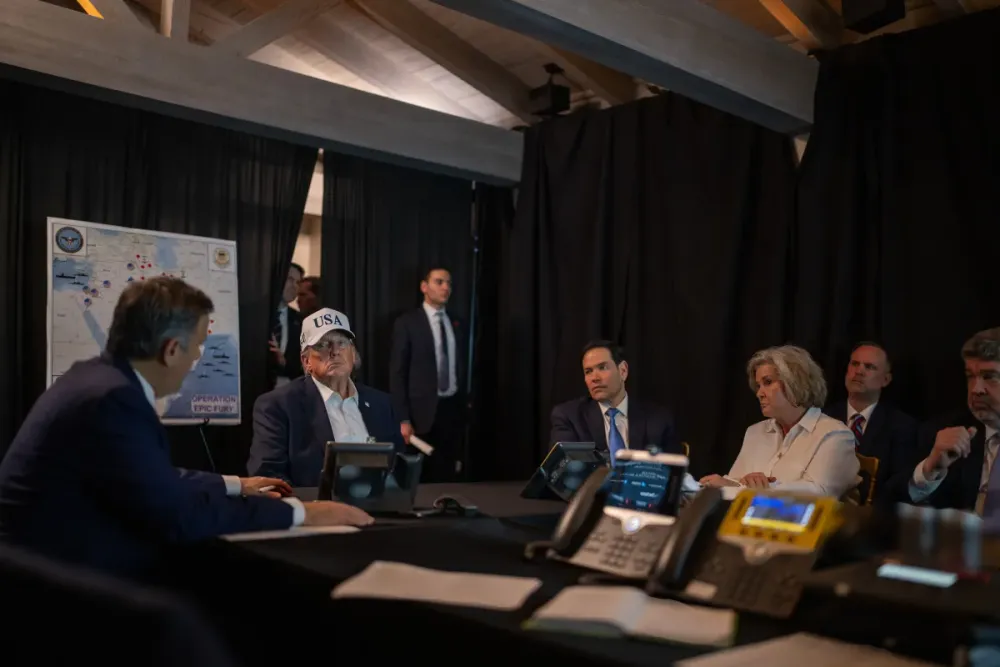
Photo: “Official White House photograph” / Source: The White House, https://www.whitehouse.gov/wp-content/uploads/2026/01/p20260103mr-0819_55022162726_o.jpg, Retrieved 2026‑01‑16. No photographer credit listed; image provided as a United States Government work. Used with editorial attribution.
Author

Nick Ravenshade, LL.B., covers geopolitics, financial markets, and international security through primary documents, official filings, and open-source intelligence. Founder and Editor-in-Chief of NENC Media Group and WarCommons.
Sign up for NENC Now newsletters.
Stay up to date with curated collection of our top stories.