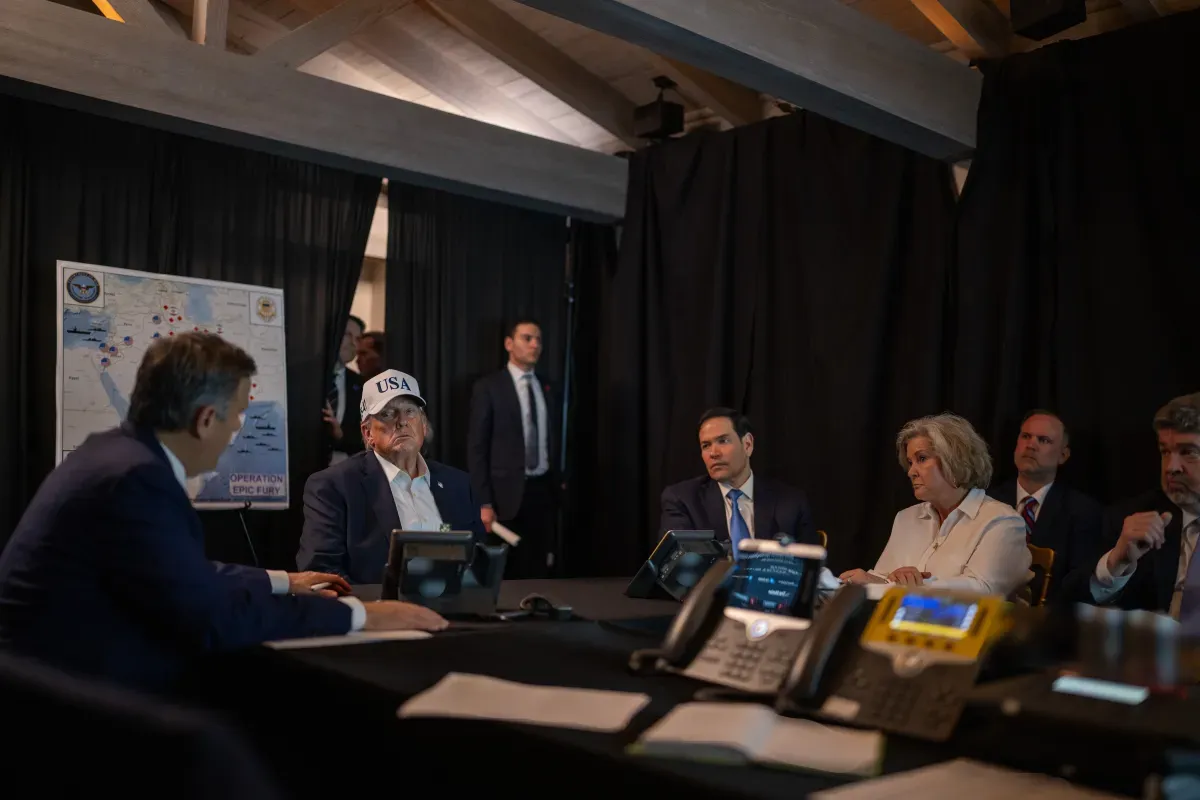
WASHINGTON — Just days after the United States and Israel launched coordinated surprise strikes against Iran in the predawn hours of February 28, President Donald Trump offered the American public a firm reassurance: the military campaign would be over in four to five weeks, and it would not become another open-ended entanglement of the sort that defined the wars in Afghanistan and Iraq. Senior officials quickly amplified that message. Yet independent analysts, foreign policy scholars, and security experts are raising pointed questions about whether that promise is achievable given the scale of Iranian retaliation, the absence of a credible post-conflict plan, and the unresolved political questions at the heart of the campaign.
A Campaign That Began With Overwhelming Force
The joint strikes, launched against at least nine Iranian cities including Tehran, Isfahan, Qom, Karaj, and Kermanshah, represented the largest concentration of American military power in the Middle East in a generation. B-2 stealth bombers armed with 2,000-pound munitions, Tomahawk cruise missiles, F/A-18 Super Hornets, and F-35 fighter jets all participated. In the first twelve hours alone, American forces conducted more than 900 strikes against Iranian targets. Iran's Supreme Leader, Ayatollah Ali Khamenei, was killed when his compound in Tehran was struck and destroyed.
President Trump announced the campaign in a social media post published at 2:00 AM Eastern Time, without a public address or a full congressional briefing beyond a notification to the bipartisan Gang of Eight intelligence leaders. The White House outlined four stated objectives: preventing Iran from acquiring a nuclear weapon, destroying its ballistic missile arsenal and production sites, degrading its regional proxy networks, and crippling its naval capabilities. The operation's underlying political aim, however, was regime change from within, with Trump directly urging Iranians to seize control of their government when the strikes commenced.
Iran Strikes Back Across the Region
Tehran's response, designated Operation True Promise IV, has been swift, geographically broad, and operationally aggressive. Iran launched approximately 420 ballistic missiles and drones at American military installations and allied nations across the region, striking targets in Israel, Jordan, Kuwait, Bahrain, Qatar, and the United Arab Emirates. Explosions were reported in Dubai and Abu Dhabi. The U.S. Embassy in Kuwait was struck and subsequently closed indefinitely. By early March, six American service members had been killed in the conflict, with at least four identified by the Pentagon following a drone strike in Kuwait that targeted personnel housed in a building with limited defenses.
Tehran has also threatened the Strait of Hormuz, the narrow chokepoint through which a significant portion of the world's oil supply travels daily. A senior Islamic Revolutionary Guard Corps commander warned that no tankers would be permitted through the strait. Two commercial vessels were struck in the opening days of fighting. European natural gas prices surged more than 40 percent after Qatar temporarily suspended operations at a gas export facility following an Iranian attack. The State Department extended evacuation orders for non-emergency personnel across at least six countries in the region, warning that militant attacks on transportation hubs, hotels, and locations associated with Jewish and Israeli communities could occur with little or no warning.
A Timetable That Has Already Begun to Shift
Trump's stated four-to-five-week timeline has proved elastic under scrutiny. He told one media outlet the operation could conclude in four weeks or less, told another it would take four to five weeks, and in subsequent remarks acknowledged it could extend considerably longer depending on Iranian resilience. In the formal written notification to Congress, Trump stated that it was not possible to know "the full scope and duration" of operations that might be required. In a separate social media post, he contended that the United States possessed a "virtually unlimited" supply of munitions and that wars could be fought "forever" using American weapons stocks.
Independent security and Middle East analysts have not been reassured. Experts across several institutions have publicly warned that while Washington clearly wants a swift resolution, the battlefield realities point toward bracing for a potentially extended conflict. Iran, these analysts note, is a country of nearly 90 million people with a deep, institutionalized security apparatus spanning nearly half a century of organizational development. Establishing any stable political transition, let alone a legitimate interim authority, will be extraordinarily difficult. Such conversations, one senior analyst observed, are almost certainly premature while active combat operations continue across multiple fronts.
What History Says About Airpower and Regime Change
The deeper unresolved question is not simply how long the bombing campaign will last, but whether airpower alone can achieve the operation's central political objective. A substantial body of strategic analysis drawn from more than a century of aerial bombardment campaigns points consistently toward a single finding: sustained air campaigns can destroy infrastructure, degrade military capability, and kill commanders. They have not, on their own, toppled a functioning government.
The closest contemporary analogy is Libya in 2011, where NATO airpower contributed to the collapse of Muammar Gaddafi's rule. That outcome, however, required organized indigenous rebel forces capable of exploiting the pressure that airpower created. No comparable armed opposition exists inside Iran today. The Islamic Revolutionary Guard Corps continues to operate, and while Iran's Foreign Ministry has acknowledged that some military units are acting on standing older instructions amid the chaos following Khamenei's death, the IRGC's command infrastructure appears substantially intact and continues to direct retaliatory strikes.
One of the more counterintuitive but extensively documented findings of strategic studies is that populations under sustained foreign bombardment tend to rally around national solidarity rather than against their governments, even when those governments are widely despised. An analysis of asymmetric interstate conflicts spanning most of the past century found that coercive air campaigns most consistently failed precisely when the targeted government concluded it was fighting for its survival. Iran in 2026 may be generating exactly that dynamic.
Domestic Opposition and the Political Cost of a Ground War
No operational assessment of the conflict's likely duration can ignore a stark domestic constraint: the American public is broadly opposed to the strikes. A major national survey conducted in the first week of the conflict found that only one in four Americans supported the military campaign against Iran. Demonstrations were held outside the White House the day the strikes commenced, and opposition has been building in communities across the country. Trump's core political base, which came to power substantially on a rejection of the post-September 11 overseas military entanglements in Afghanistan and Iraq, carries deep institutional skepticism toward large-scale foreign interventions. Senior officials from Vice President JD Vance to Defense Secretary Pete Hegseth have taken pains to emphasize the operation's defined scope specifically to address those concerns.
A ground invasion, which most strategic analysts consider a prerequisite for genuine and lasting regime change, appears both politically and logistically untenable. Former senior Western defense officials have stated publicly that Iran simply is not a country whose government can be replaced from the air alone, and that any deployment of American ground forces would risk replicating the conditions that made the Iraq occupation so prolonged and costly. The Republican administration, which ran in part on ending foreign military commitments, would face severe domestic pressure if the conflict evolved into a ground campaign against a nation of nearly 90 million people with a history of fierce resistance to foreign military presence.
Munitions Strain and the Risk of Miscalculation
A further constraint looms within the Pentagon's own operational planning. Defense analysts warn that the American military is drawing down high-end precision interceptors, including Terminal High Altitude Area Defense systems and Patriot batteries, at a pace that will become strategically unsustainable if the conflict extends significantly beyond its stated timetable. During an earlier limited American strike campaign against Iranian nuclear facilities in June 2025, the U.S. burned through approximately 25 percent of its THAAD interceptor stockpile over just a few days of operations. Replenishment of such advanced systems currently takes upward of two years under existing production constraints, and those same systems are simultaneously in demand to support Ukraine's defense against Russian ballistic missiles. One senior defense policy analyst described the potential strain on interceptor capacity as deeply concerning if the current operational tempo is maintained over weeks rather than days.
Regional dynamics are also shifting in ways that complicate any clean exit. Saudi Arabia and the United Arab Emirates, which initially agreed only to intercept Iranian missiles while refusing to allow their territory to be used for offensive operations, have each issued statements signaling readiness to respond directly after Iranian strikes caused civilian casualties on their soil. Whether that evolution concentrates or broadens the conflict will depend substantially on Tehran's next strategic choices. What is already clear is that Operation Epic Fury, launched with a four-week endpoint in mind, has generated conditions that no timetable alone can resolve.
Written by Nick Ravenshade for NENC Media Group, original article and analysis.
Author

Nick Ravenshade, LL.B., covers geopolitics, financial markets, and international security through primary documents, official filings, and open-source intelligence. Founder and Editor-in-Chief of NENC Media Group and WarCommons.
Sign up for NENC Now newsletters.
Stay up to date with curated collection of our top stories.